
 3×
Insurance Guide
Insurance Quote Follow-Up: The 14-Day Text and Call Cadence, with Replies to Each Objection
Short Answer
An insurance quote follow-up is the sequence of texts and calls you send after a buyer receives a quote, to answer their questions, handle their objections, and move them to a bound policy. The cadence below covers 14 days, mixes text and call, and includes a written reply for the 3 objections that hold the most quotes.
Read the Transcript
23% of companies never answer a new lead at all. That's from a Harvard Business Review audit of 2,241 companies. The ones that replied within an hour were nearly 7 times more likely to qualify the lead. So the first text on a new insurance quote goes out inside that hour, while the buyer is still comparing. After that, the follow-up has one job: find the real objection. In J.D. Power's study, three quarters of quoted shoppers who didn't buy named price. So when a buyer says "I need to think about it," ask which part. If it's the monthly price, change the coverage together and agree on a date to decide. Every message needs written consent, an opt-out line, and a send time between 8 a.m. and 9 p.m. Answer inside the hour, then find the real objection.
An insurance quote follow-up is the sequence of texts and calls you send after a buyer receives a quote, to answer their questions, handle their objections, and move them to a bound policy. The cadence below covers 14 days, mixes text and call, and includes a written reply for the 3 objections that hold the most quotes: price, "I need to think about it", and "I have to talk to my spouse."
Every message in this guide assumes you captured written consent at the quote-to-bind step. If you did not, do not text.
- Capture Consent at the Quote FormGet signed, written consent that names your company, the phone number, and says consent is not a condition of purchase.
- Text Within the Hour of the QuoteConfirm the quote arrived, name the coverage, ask one question, include an opt-out line.
- Call on Day 1 If the Text Goes UnansweredCall during business hours. Leave a voicemail that references the quote and your text.
- Text on Day 3 with a Coverage DetailAdd one fact about their quote they may not have noticed, such as a bundling option or a deductible choice.
- Call on Day 5, Then Text If No AnswerTry a different time of day. If voicemail, follow with a short text.
- Text on Day 7 with a Deadline or ChangeIf the quote expires, name the date. If rates changed, say so.
- Call on Day 10Last call attempt. Ask directly whether they have decided or if something is holding them back.
- Text on Day 14, Close the LoopTell them you are closing the quote file and they can reach you if anything changes. No pressure, clear close.
How Soon Should You Follow Up After Sending a Quote?
Within the hour.
In an HBR audit of 2,241 US companies (Oldroyd, McElheran, Elkington, March 2011), firms that contacted an online lead within an hour were nearly 7 times as likely to qualify it as firms that waited a second hour, and more than 60 times as likely as firms that waited a day or longer. The older MIT and InsideSales.com study (2007) found contact odds 100 times higher at 5 minutes than at 30.
Both studies are cross-industry and measure contact and qualification, not binds. No public study ties first-contact timing to bind rate in insurance. Still, the direction is clear: the quote is freshest in the buyer's mind the moment it arrives, and every hour you wait gives them time to open a competitor's quote instead.
With shoppers now collecting 3.5 quotes on average (J.D. Power 2026 Insurance Shopping Study, via CBT News, released 2026-06-04) and 77% of them quoting with only 1 or 2 insurers (TransUnion, Q4 2025, via Insurance Journal, 2026-03-04), being the first voice they hear after the quote matters.
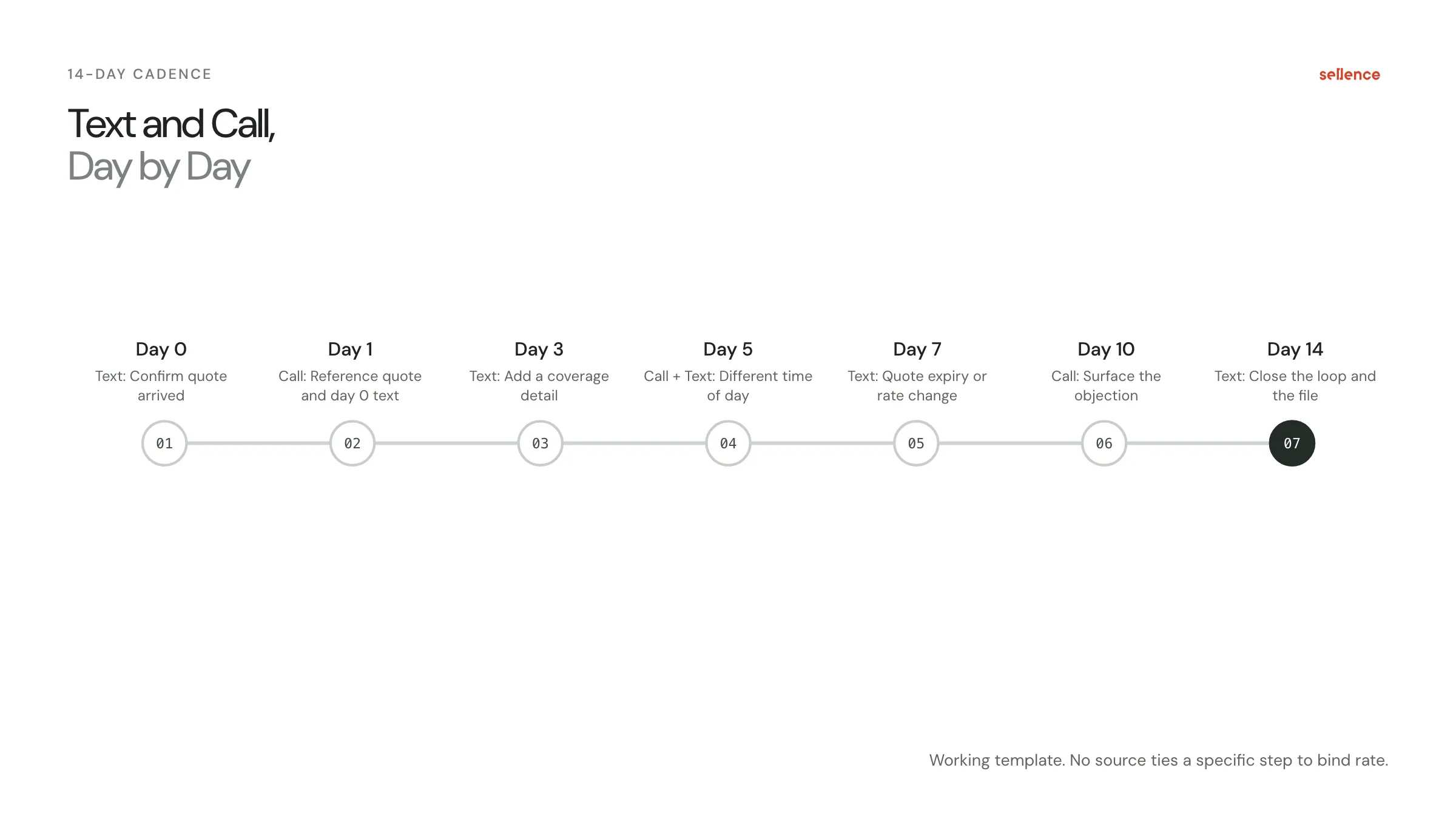
The 14-Day Text and Call Cadence
This is a working template. No source attaches a bind rate to any specific cadence step, so test it against your own numbers and adjust.
Table: 14-day follow-up cadence
| Day | Channel | What you send | Why this day |
|---|---|---|---|
| 0 (within 1 hour) | Text | Confirm the quote arrived, name the line and vehicle/property, ask 1 question, opt-out line | Quote is fresh; confirms delivery |
| 1 | Call | Reference the quote and your day-0 text; if voicemail, leave your name, the line quoted, and a callback number | Voice adds a face to the text; a second channel raises reach |
| 3 | Text | Add 1 coverage detail they may not have seen (bundle option, deductible choice, roadside) | Gives them a reason to reply beyond "yes/no" |
| 5 | Call, then text | Try a different time of day; if voicemail, follow with a short text | Spacing avoids pressure; time-of-day change catches a different window |
| 7 | Text | If the quote has an expiry, name the date; if rates shifted, say so | A real deadline or a rate change is a reason to act |
| 10 | Call | Ask directly: have you decided, or is something holding you back? | Surfaces the objection for the first time if they have been silent |
| 14 | Text | Tell them you are closing the file; they can reach you anytime | Gives them an out, which sometimes prompts a reply |
Table note: Every text includes an opt-out line ("Reply STOP to opt out"). Every call is inside federal quiet hours (8 a.m. to 9 p.m. recipient local time; some states are tighter). Consent must be captured before day 0.
What to Put in Each Message
One fact about their quote, and one question. The fact shows you know the quote. The question gives them a reason to reply.
Day-0 example: "Hi [Name], it's [Agent] at [Agency]. Your auto quote for both the 2021 Accord and the 2019 RAV4 is in your inbox, $187/mo with full coverage. Did it come through OK? Reply STOP to opt out."
Day-3 example: "Hi [Name], quick note on your quote. Your home policy is with [Carrier], and bundling auto with them would drop the combined premium by about $22/mo. Want me to run that number? Reply STOP to opt out."
Day-7 example: "Hi [Name], your auto quote expires on [date]. Rates in [state] went up [X]% this month, so this price holds until then. Let me know if you want to lock it in. Reply STOP to opt out."
Day-14 example: "Hi [Name], I'm closing your quote file for now. If anything changes or you want to revisit the numbers, just text me back. Reply STOP to opt out."
How to Politely Follow Up on a Quote
The people, agency and coverage in this example are invented. The buyer gave written consent to texts on the quote form.
Day 0, 2:05 p.m. (quote emailed at 1:40 p.m.)
Agent: Hi Sam, it's Chris at Beacon Insurance. Your auto and home bundle quote is in your inbox, $312/mo for both. Did it come through? Reply STOP to opt out.
Sam: yeah got it. its more than i expected honestly
Agent: Thanks for saying that. The home portion has a $1,000 deductible right now. Want me to price it at $2,500? That brings the monthly down by [$X].
Sam: sure but i need to talk to my wife first
Agent: Makes sense. I'll send a side-by-side of both deductible options so you can look at it together. Are you two looking at it tonight or this weekend?
Sam: probably this weekend
Day 3, 10:15 a.m.
Agent: Morning Sam. One thing on the quote: your Accord has roadside through your existing plan, so I removed the duplicate on the new policy. Saves about $6/mo. Let me know if you and your wife had a chance to compare the 2 options. Reply STOP to opt out.
Sam: we looked at it. the 2500 deductible one. can we start the 1st?
Agent: Yes. Here is the link to sign and pay, with a start date of November 1. [link]
The pattern: every message references something specific about Sam's quote or Sam's last reply. The spouse objection gets something to forward and a date. The price objection gets a coverage change and a new number.
How to Handle Objections in Insurance Sales
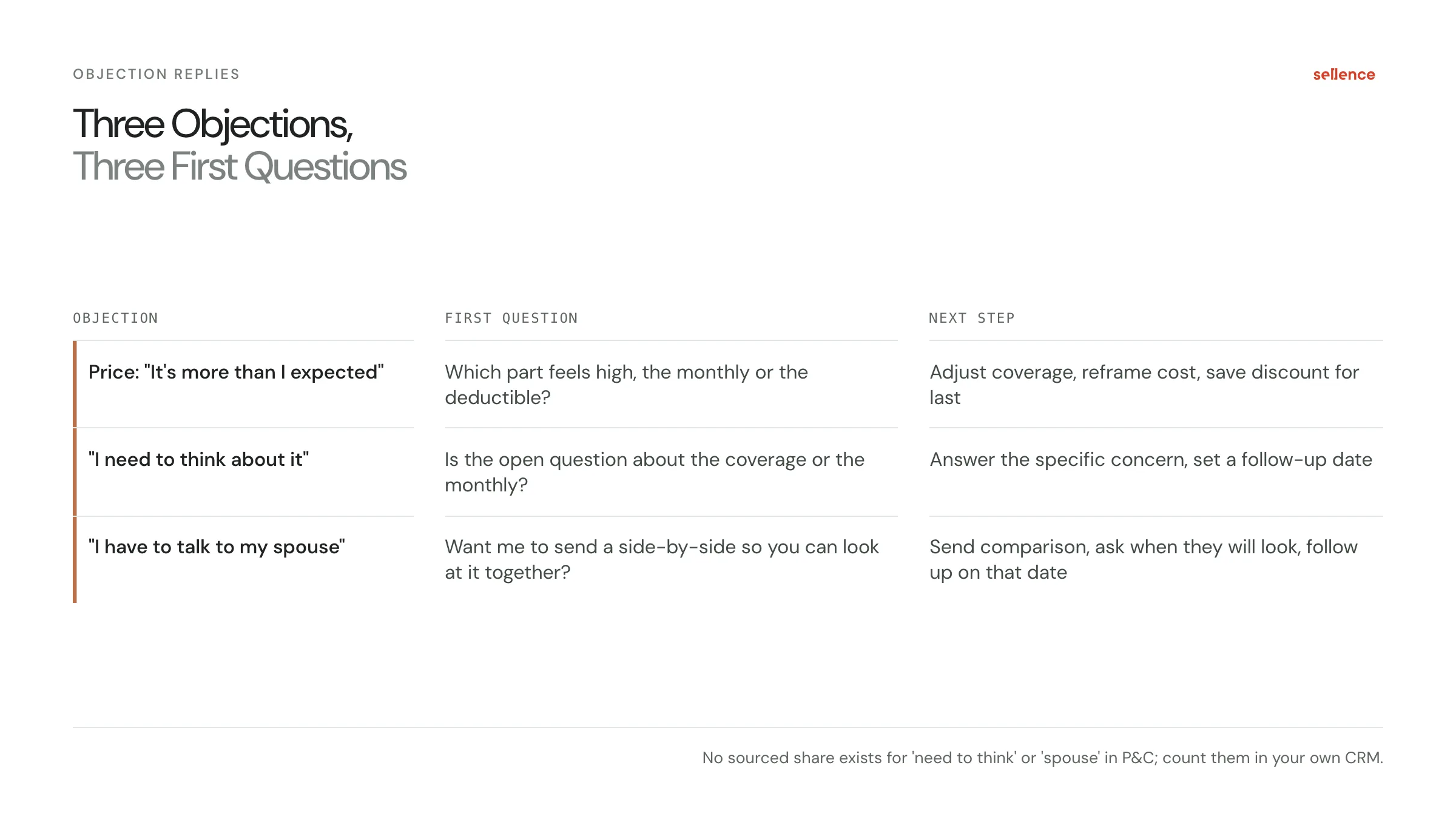
Three objections hold the most quotes. Below is a written reply for each.
Price: "It's More Than I Expected"
Price is the objection with the most evidence behind it. In J.D. Power's 2010 study, 76% of quoted shoppers who did not buy cited price. In life insurance, cost is the top barrier for 45% of adults with a coverage gap (2026 Insurance Barometer Study, LIMRA and Life Happens, fielded January 2026, n=5,237).
What to ask: "Which part feels high, the monthly or the deductible?" The answer tells you whether to adjust coverage or reframe the cost.
What to do:
- If the monthly is the issue, raise the deductible, remove a rider they do not need, or re-shop a different carrier.
- If the deductible feels risky, show what a claim would cost at each level.
- If they are comparing to another quote, ask to see the other quote's declaration page. Coverage differences explain most price gaps.
- Save the discount for last. Changing coverage first shows you are solving the problem.
Reply template (text): "I hear you on the price. Your quote has a $500 deductible with full glass coverage. Want me to price it with a $1,000 deductible and without glass? That would move the monthly down by about [$X]. Reply STOP to opt out."
"I Need to Think About It"
No sourced share exists for this objection in P&C insurance. In life insurance, "not getting to it" is a barrier for 23% of adults with a need gap (LIMRA 2026).
"I need to think about it" usually means one of 3 things: the price feels high but they do not want to say so, they do not understand part of the coverage, or they genuinely need time and permission to slow down is the right move.
What to ask: "Totally fair. Is there a part of the coverage you want me to walk through, or is it more about the number?"
What to do:
- If it is the price, follow the price reply above.
- If it is the coverage, answer the specific question and ask if that clears it up.
- If they need real time (a pay period, a lease date, a household conversation), set a specific follow-up date: "I'll text you Thursday. Does that work?"
- Never end with "take all the time you need." End with a date.
Reply template (text): "No rush at all. Is the open question about the coverage or the monthly? Happy to walk through whichever part. Reply STOP to opt out."
"I Have to Talk to My Spouse"
What to ask: "Makes sense. Want me to send a side-by-side of the 2 options so you can look at it together?"
What to do:
- Send a short comparison they can forward (2 columns: option A coverage and price vs option B).
- Ask when they will look: "Are you two looking at it tonight or this weekend?"
- Follow up on the date they gave you, not before.
- If the spouse has a specific concern (a claim history, a deductible preference), address it in the follow-up text by name.
Reply template (text): "Got it. I'll send a side-by-side of both options so you can forward it. When are you two planning to sit down with it? Reply STOP to opt out."
Consent Note for Every Message
This is general information, not legal advice. TCPA rules changed several times in 2025 and 2026, and courts disagree by circuit. Check with counsel before changing consent language or opt-out handling.
- Capture written consent at the quote form. Under 47 CFR 64.1200(f)(9), prior express written consent is a signed agreement (e-signature counts) that names the company, the phone number, and says consent is not a condition of purchase.
- Every text includes an opt-out line. "Reply STOP to opt out" covers the standard words.
- Honor any opt-out within 10 business days (64.1200(a)(10)). One text confirming the opt-out is allowed.
- A STOP reply to a marketing follow-up ends all marketing calls and texts from your company.
- Federal calling hours are 8 a.m. to 9 p.m. in the buyer's local time (64.1200(c)(1)). Some states are tighter: Florida's cutoff is 8 p.m.
- The FCC adopted FCC 26-67 on 2026-09-30. It takes effect 30 days after Federal Register publication, which had not happened as of 2026-10-11. Once in effect, a company may name a single opt-out method if every message discloses it. Check the effective date before relying on it.
FAQ
How Soon Should You Follow Up After Sending a Quote?
Within the hour. A cross-industry HBR audit of 2,241 US companies found firms that replied within an hour were nearly 7x more likely to qualify the lead than firms that waited a second hour.
How Do You Politely Follow Up on a Quote?
Reference the specific quote (line, vehicle, coverage), ask one question about it, and include your opt-out line. A fact about their quote beats a generic check-in.
How Do You Handle Objections in Insurance Sales?
Ask one question to surface the real concern, reframe around coverage fit or household risk, and propose a concrete next step with a date.
Sources
- Oldroyd, McElheran and Elkington, "The Short Life of Online Sales Leads", Harvard Business Review, March 2011. https://hbr.org/2011/03/the-short-life-of-online-sales-leads
- Oldroyd and Elkington, Lead Response Management Study (InsideSales.com and MIT), 2007-10-16. https://www.mortech.com/hs-fs/hub/25649/file-13535879-pdf/docs/mit_study.pdf
- J.D. Power, 2026 U.S. Insurance Shopping Study, released 2026-06-04, reported by CBT News. https://www.cbtnews.com/digital-is-the-new-front-door-for-auto-insurance/
- TransUnion, Insurance Personal Lines Trends and Perspectives, Q4 2025, released 2026-02-10, reported by Insurance Journal 2026-03-04. https://www.insurancejournal.com/news/national/2026/03/04/860336.htm
- J.D. Power 2010 Insurance Shopping Study, reprinted by Insurance-Canada.ca, 2010-05-25. https://insurance-canada.ca/2010/05/25/j-d-power-and-associates-reports-importance-of-price-to-us-insurance-shoppers-increases-while-satisfaction-with-price-decreases/
- LIMRA and Life Happens, 2026 Insurance Barometer Study, fielded January 2026. https://www.limra.com/siteassets/newsroom/liam/2026/2026-barometer-member-pr-toolkit.pdf
- eCFR, 47 CFR 64.1200, version dated 2026-10-01. https://www.ecfr.gov/current/title-47/chapter-I/subchapter-B/part-64/subpart-L/section-64.1200
- FCC 26-67, Report and Order and FNPRM, adopted 2026-09-30. https://docs.fcc.gov/public/attachments/FCC-26-67A1.pdf
Sellence built the persuasion model that follows up on quotes by text and call in your agency's name, handles each objection in the thread, and follows through to the buyer's decision. At VOOM Insurance it delivered a 50% increase in conversion rate on quote abandonment. See how it works for insurance or book a demo.
FAQ
How soon should you follow up after sending a quote?
Within the hour. A cross-industry HBR audit found firms that replied within an hour were nearly 7x more likely to qualify the lead than firms that waited a second hour.
How do you politely follow up on a quote?
Reference the specific quote (line, vehicle, coverage), ask one question about it, and include your opt-out line. A fact about their quote beats a generic check-in.
How do you handle objections in insurance sales?
Ask one question to surface the real concern, reframe around coverage fit or household risk, and propose a concrete next step with a date.